Writing the Spec
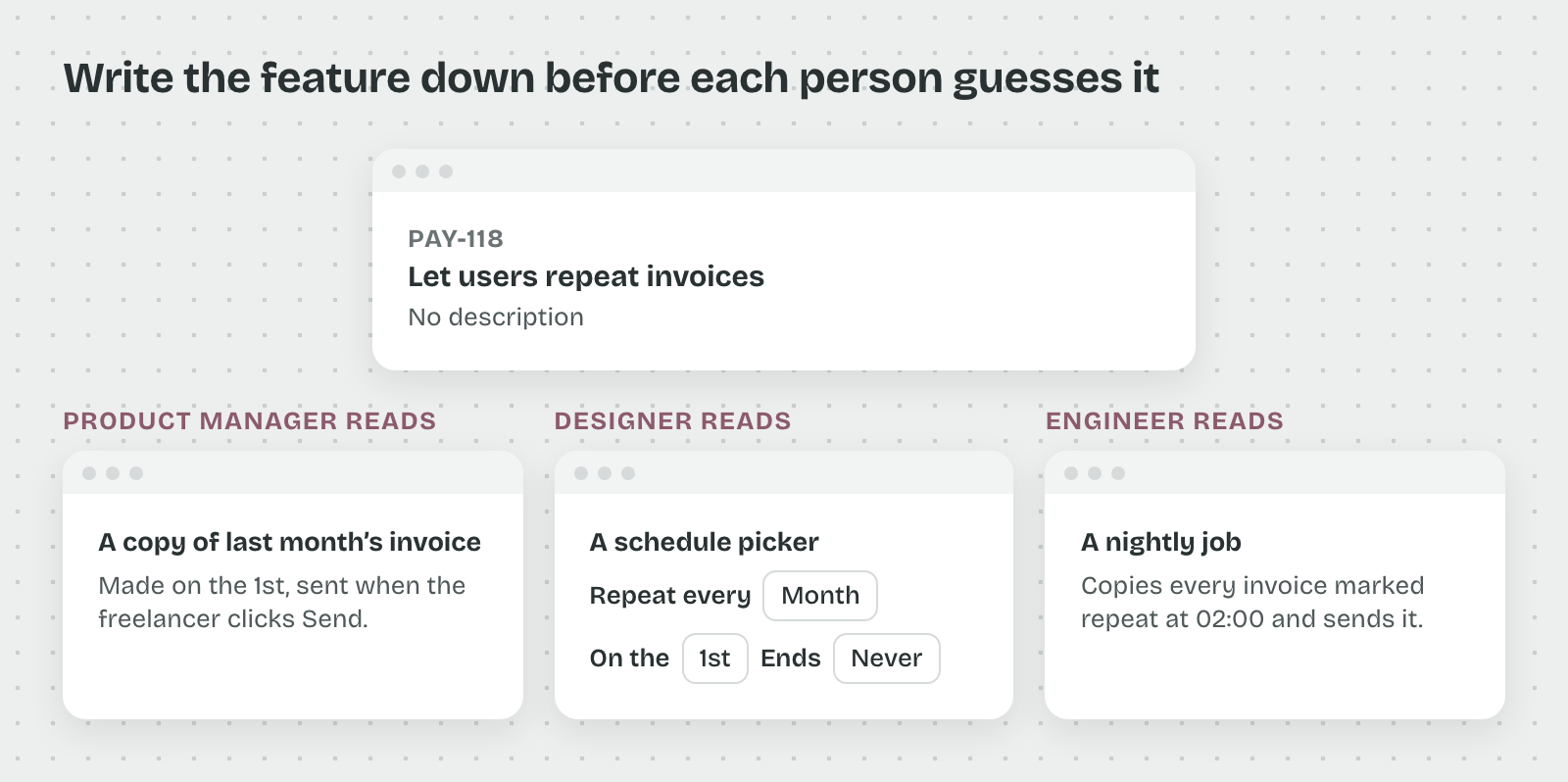
Design, product and engineering can leave one planning meeting with three different versions of the same feature. Imagine an invoicing app planning recurring invoices. The product manager means a monthly copy of last month's invoice, the designer has drawn a full schedule picker, and the engineer has sized a nightly job. Nobody notices until the last ten minutes of planning.
Learn on the move: press play and turn your commute, walk or drive into time that grows your design career.


So a spec writes the feature down before anyone builds it. It's one page that names the problem, what's in and out, how the team will know it worked, and who decides. Everybody reads the same page, so the three versions become one.
Where the Spec Sits
The spec sits between a decided bet and the first ticket. A roadmap says the team will work on recurring invoices this quarter. The spec says what exactly gets built, and the tickets then split that into work for one person each.
That gap is expensive when it stays open. In PMI's 2014 Pulse of the Profession survey of 2,066 project managers and analysts, 47% of unsuccessful projects missed their goals because of poor requirements management. The same report put the waste at 5.1% of every dollar spent on projects.
A spec closes that gap only if people read all of it, so its length matters too. Malte Ubl, describing design docs at Google in 2020, puts a large one at 10 to 20 pages and a mini one at 1 to 3. In the same spirit, Amazon keeps the press release at the top of its PR/FAQ under one page, as Colin Bryar and Bill Carr describe in Working Backwards (2021). A feature spec belongs at the short end, so everyone reads all of it before the meeting.
In practice the spec also hands work on to three neighbors. Tickets and acceptance criteria are taught in Tickets & User Stories, the handoff package in Documentation & Handoff, and choosing a success metric in Goals & OKRs.
Anatomy of a Spec
A short ticket leaves every decision about a feature to whoever builds it. Imagine recurring invoices described in a ticket as “Let users repeat invoices.” Two weeks later the engineer demos a nightly job, and the designer's schedule picker has nowhere to go. Here is that one line read three ways:
So a one-page spec gives every reader the same parts in the same order. Each part answers a question somebody would otherwise ask in the middle of the build.
The Parts of a Spec
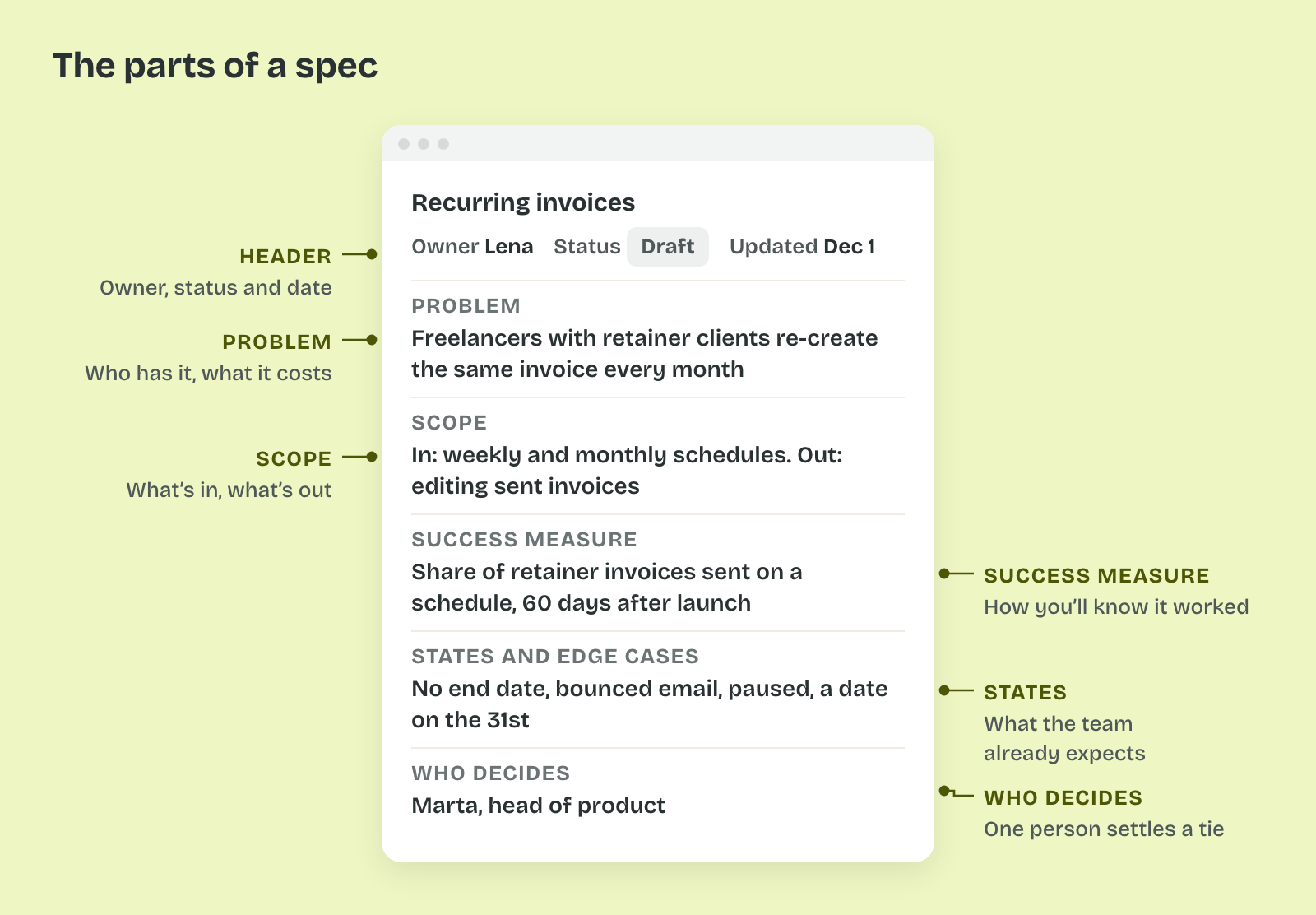
A one-page spec has a header and five parts. The header names the owner, the status and the date, the same document properties Atlassian puts at the top of its product requirements template. The five parts follow in the order a reader needs them:
- Problem: who has it and what it costs them today.
- Scope: what this release includes and what it leaves out.
- Success measure: the signal that shows the problem got smaller.
- States and edge cases: the situations the team already knows about.
- Who decides: the one person who settles a disagreement.
That shape is common across teams under different names. Ryan Singer's Shape Up (Basecamp, 2019) gives a pitch five ingredients: problem, appetite, solution, rabbit holes and no-gos. Here is a one-page spec for recurring invoices with each part named:
The Problem Comes First
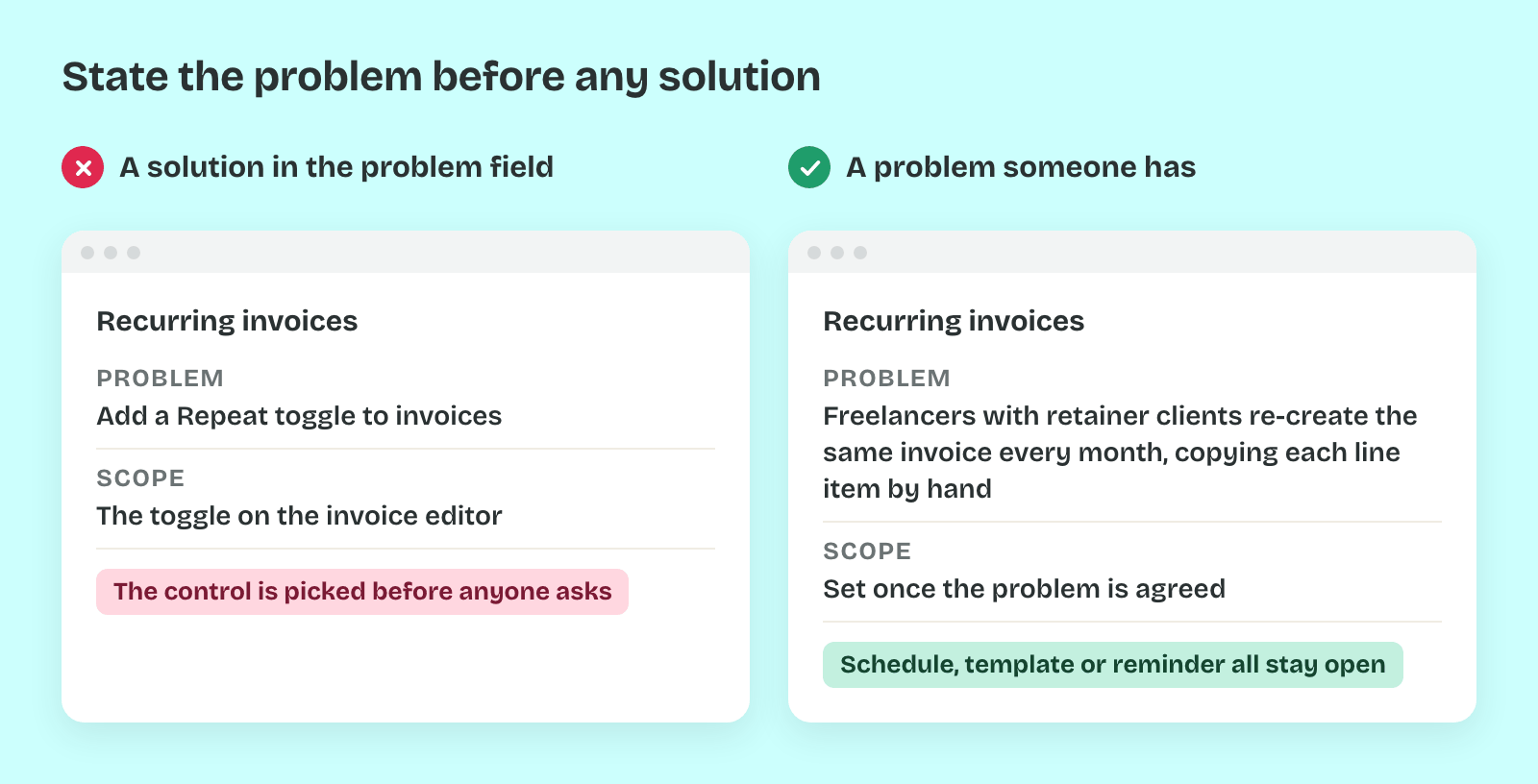
The problem goes at the top, before any solution. It names a real group of users, what they do today and what that costs them. “Freelancers with retainer clients re-create the same invoice every month, copying each line item by hand” gives the team something to check every later decision against.
That check breaks when the problem is written as a solution, which is a common mistake. “Add a Repeat toggle to invoices” has already picked the control. Nobody then asks whether freelancers wanted a schedule, a template or a reminder. Here is the same problem written as a solution and as a problem:
Scope and the Success Measure
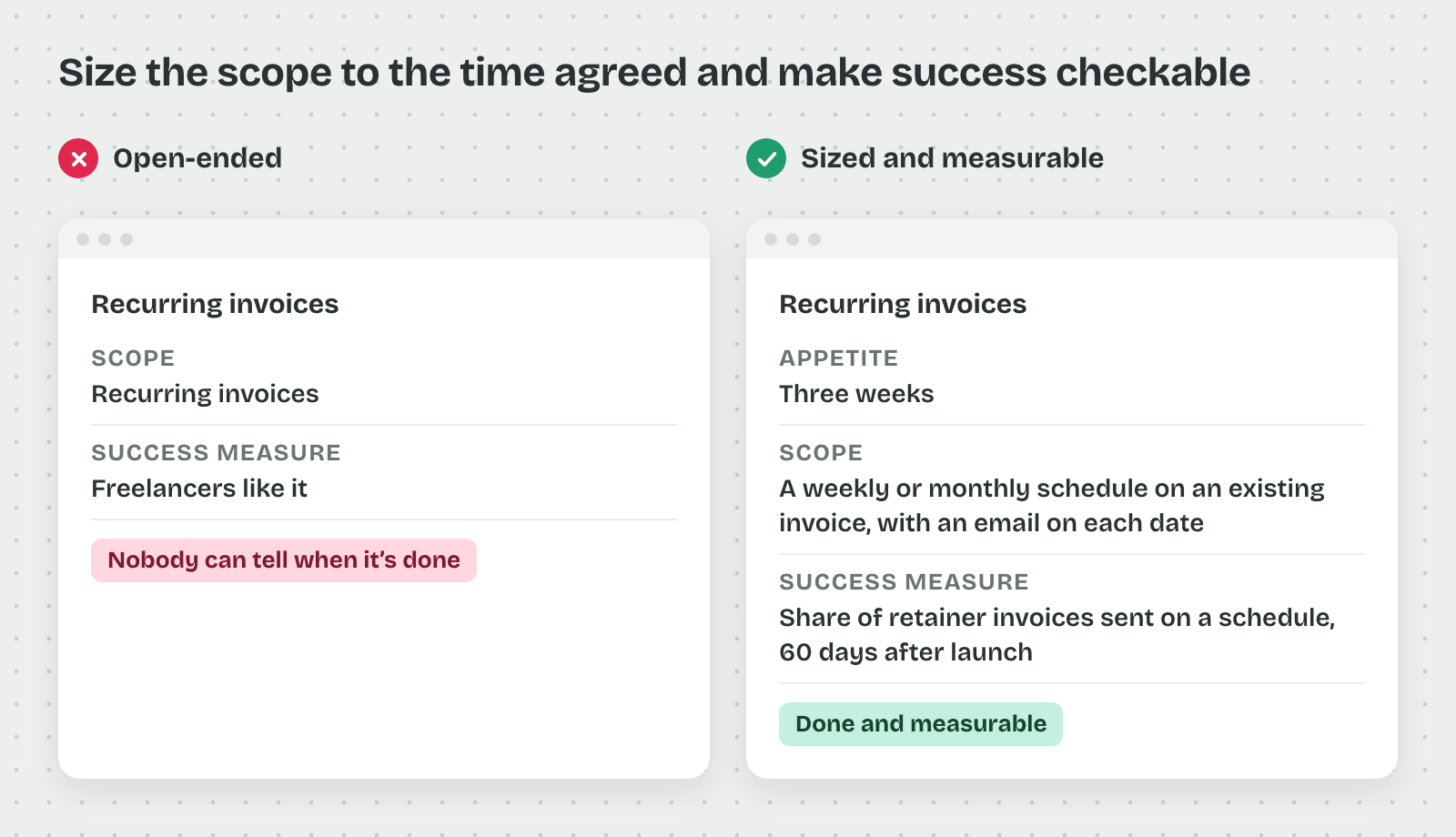
Scope says what this release includes, sized to the time the team has agreed to spend. Shape Up calls that time the appetite and sets it before the solution, so the scope fits it. For recurring invoices, the scope might be a weekly or monthly schedule on an existing invoice, with an email sent on each date.
Once the scope is set, the success measure says how the team will know the problem got smaller. One line is enough, such as the share of retainer invoices sent on a schedule 60 days after launch. Choosing that metric well is the job of Goals & OKRs, so the spec records the one the team picked. Here is the same scope and measure written open-ended and written to be checked:
States, Edge Cases and Who Decides
The states part lists the situations the team already knows will happen. For recurring invoices, that means a schedule with no end date, a client email that bounces, a paused schedule and a send date on the 31st. A list is enough here, because the states come from the complexity map in Design Workflows. Drawing each one belongs to Documentation & Handoff.
That list saves an argument later, since an edge case written down before the build gets a decision instead of a guess. A monthly date on the 31st in a 30-day month is the kind an engineer otherwise settles alone during the build.
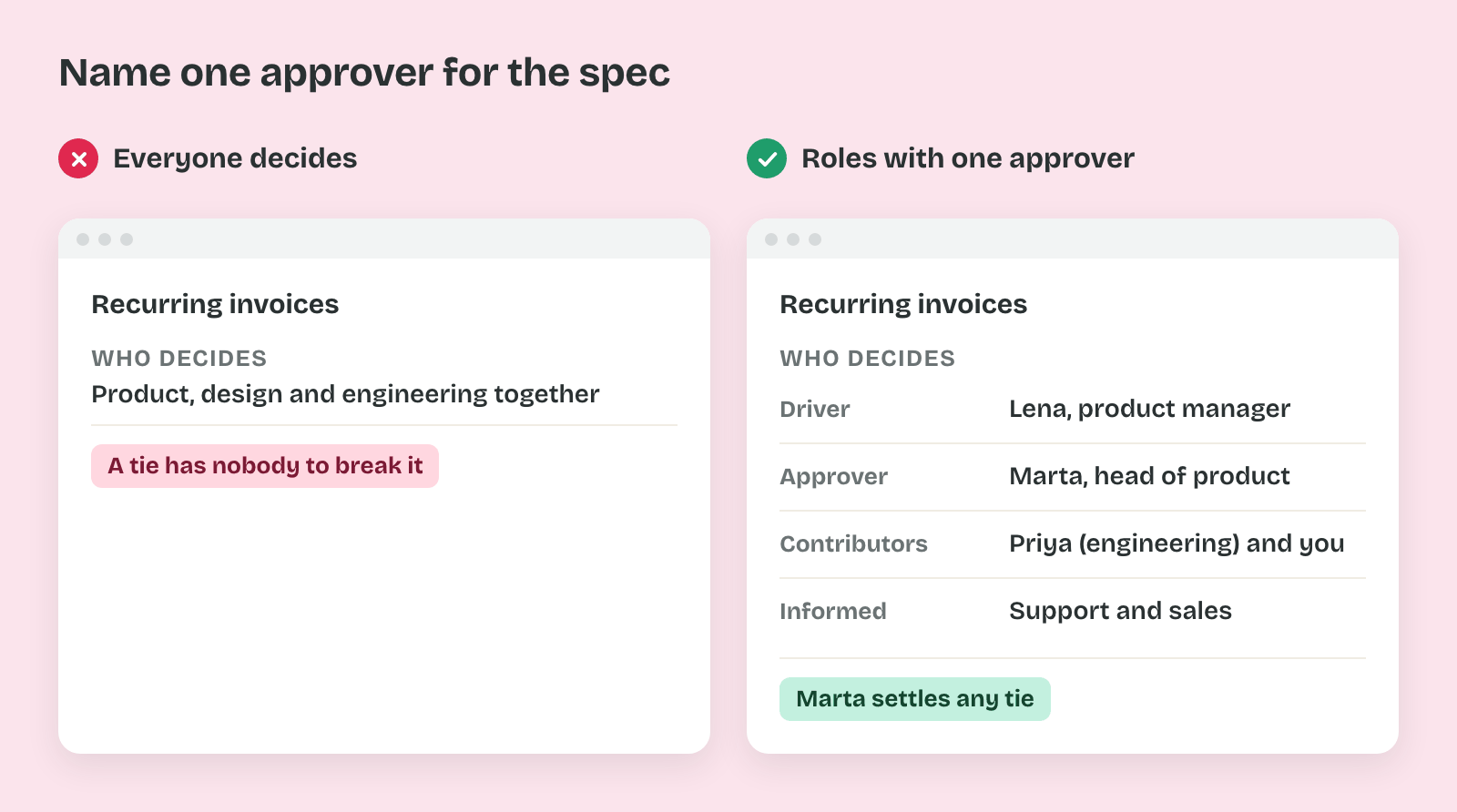
An edge case still needs someone to settle it, so the last part names who decides. Atlassian's DACI framework splits a decision into a driver, an approver, contributors and people informed. It insists on exactly one approver, so a tie always has someone to break it. Here are the DACI roles for recurring invoices:
Pro tip: Write the problem part first and show it to one engineer before writing the rest. If they can say it back in their own words, the other four parts get much easier to agree.