The Product Development Lifecycle
Ask five people on a product team where a new feature stands and you'll often get five answers. The designer says it's in research, engineering says it's being estimated, and marketing has already drafted the launch post. Each is describing a different stage, and nobody can see the whole path.
Learn on the move: press play and turn your commute, walk or drive into time that grows your design career.

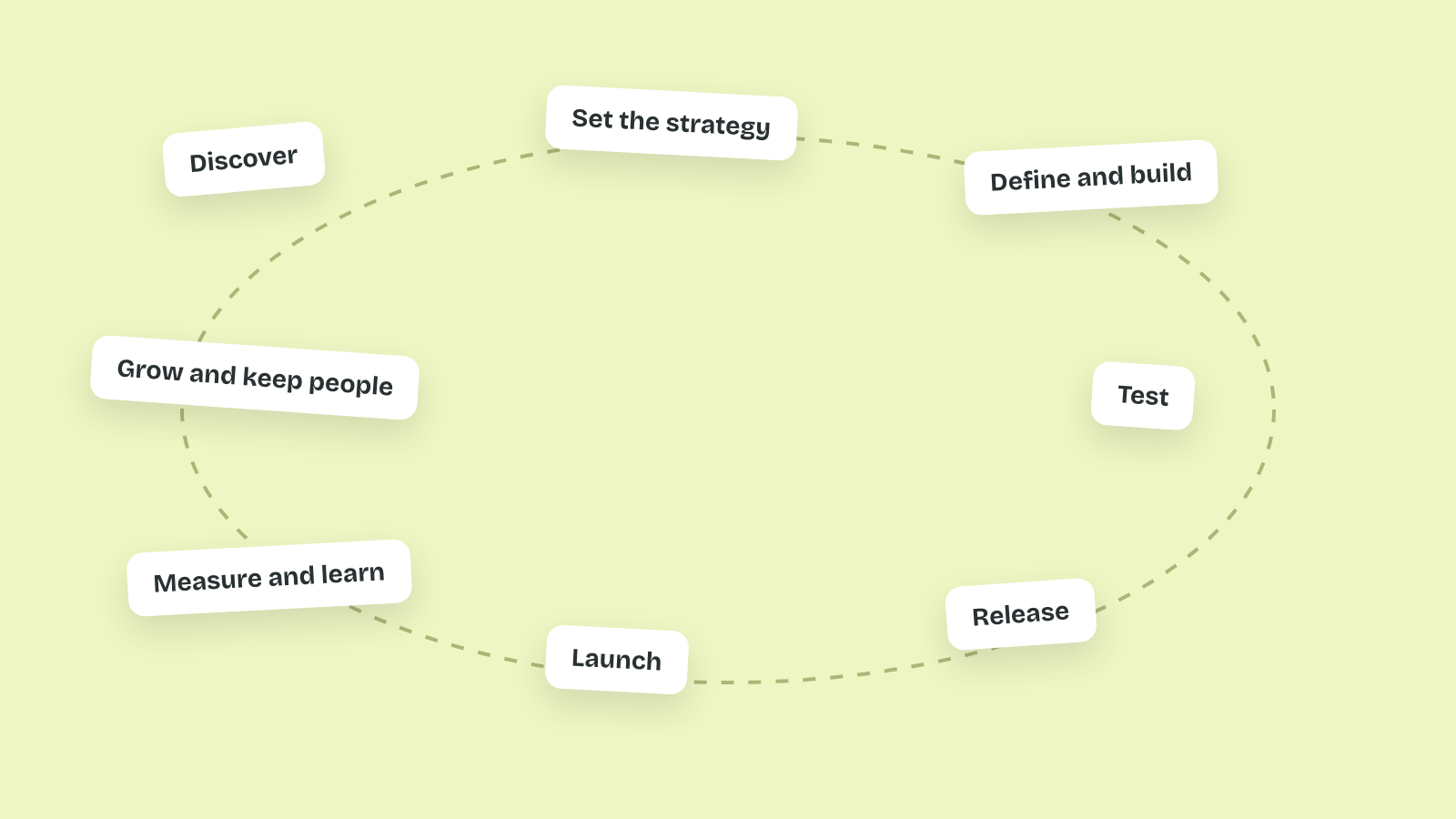
That path has a shape. Product work moves through a set of stages, from discovering what's worth building to keeping the people who use it, and then loops back with what it learned.
So the lifecycle is a map of where any piece of work stands. It names each stage, what happens there, what designers do and where the course teaches it in full.
The Whole Loop at a Glance
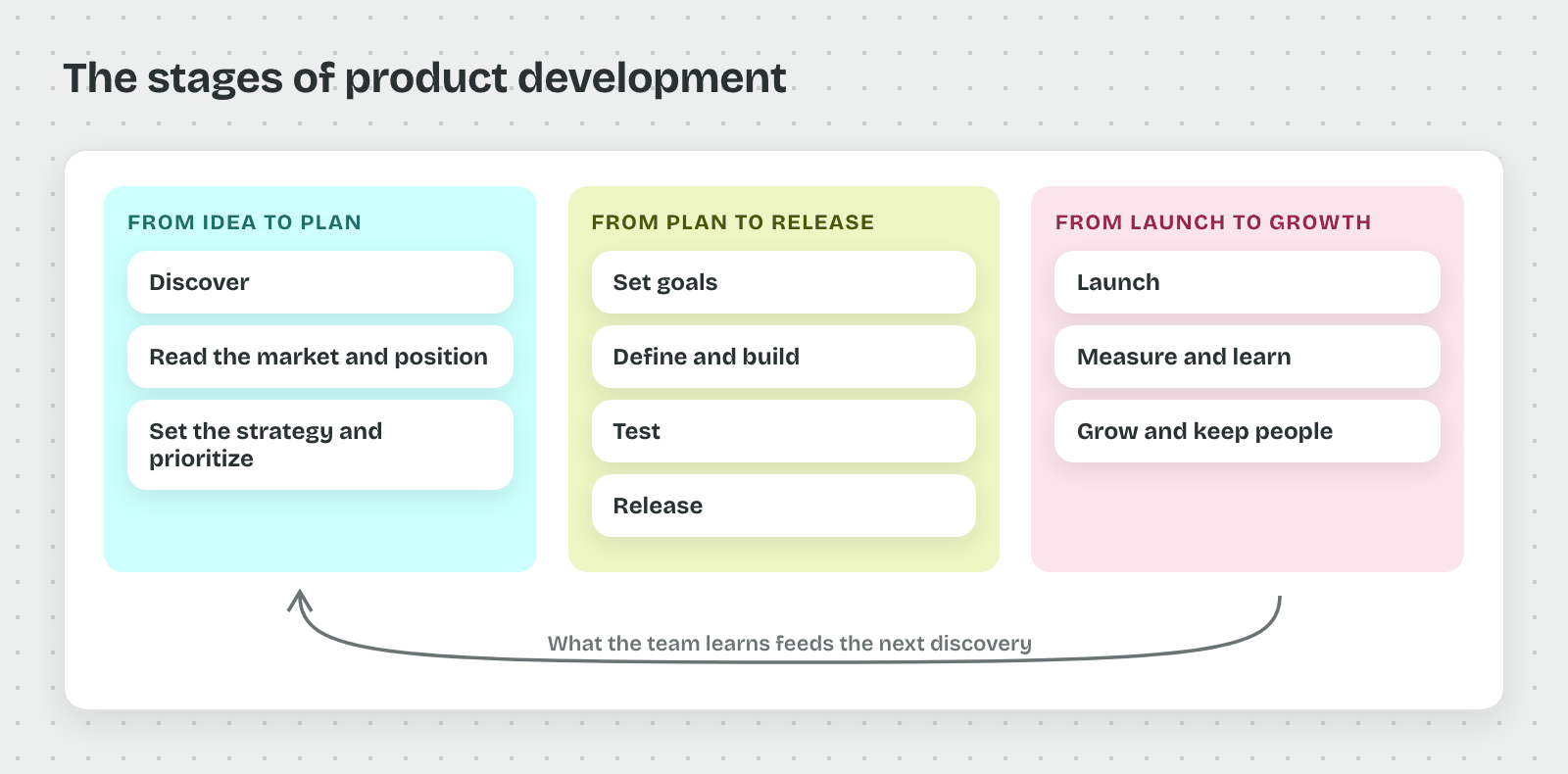
The stages fall into three groups. From idea to plan: discover, read the market and position, set the strategy and prioritize. From plan to release: set goals, define and build, test and release. From launch to growth: launch, measure and learn, and grow and keep people.
The groups aren't a one-way line. Teams run discovery for the next idea while delivery builds the current one, and what they measure after launch feeds the next round of discovery. The Design Council's Double Diamond, published in 2005, describes the design side of the first half: diverge to understand the problem, then converge on what to build.
What Designers Do Across the Stages
Designers work in every stage, and the work changes shape. Early on it's research and rough sketches made to learn. In the middle it's detailed design, specs and checks of the build. After launch it's reading behavior and improving the experience. Each stage also serves the strategy, either by testing it with evidence or by carrying it out.
From Idea to Plan
A founder sees a gap, the team gets excited, and engineering starts within a week. Many products die at exactly this point, long before launch. When CB Insights studied the post-mortems of startups that shut down in 2021, 35% named no market need as a reason.
The first stages of product work exist to catch that early. They decide whether the idea is worth building, where it will compete and what comes first.
Discover
Discovery checks the problem before anyone builds a solution. The team states the problem, maps its riskiest assumptions, talks to the people who have it and tests the bet cheaply. The output is a bet the team believes in, with real evidence behind it. A week of interviews can be enough to drop a weak idea, which is the cheapest win the whole process offers.
Designers run interviews and rough prototype tests here, and turn what they hear into problem statements. The common mistake is skipping straight to solutions because the idea feels obvious. Product Discovery teaches this stage in full.
Read the Market and Position
The market stage asks how big the opportunity is, who else is chasing it and how the product will stand apart. The team sizes the market, maps competitors and writes a positioning statement that names who the product is for and why it's different. Positioning also decides who the team says no to, which keeps later design decisions simpler.
Designers benchmark rivals' experiences and help shape how the difference shows up in the product. The common mistake is positioning against features while customers choose on experience. Market & Positioning teaches this stage.
Set the Strategy and Prioritize
With evidence in hand, the team sets direction: a vision, a strategy, where to play and how to win. Then it decides what comes first and turns that order into a roadmap people can see.
Designers sketch the vision, estimate design effort and argue for the impact on users when work gets ranked. The common mistake is a roadmap that lists features with no strategy behind it, so every request looks equally urgent. Prioritization & Roadmapping teaches this stage.
How the Three Connect
These stages feed each other in both directions. Discovery supplies the evidence for the strategy, and the market read decides whether a real need is big enough to pursue. The roadmap then sends the team back to discovery for the next unknown.
That's why they rarely run in a neat order. A team often loops through them several times before a plan holds, and each loop costs far less than building the wrong thing.
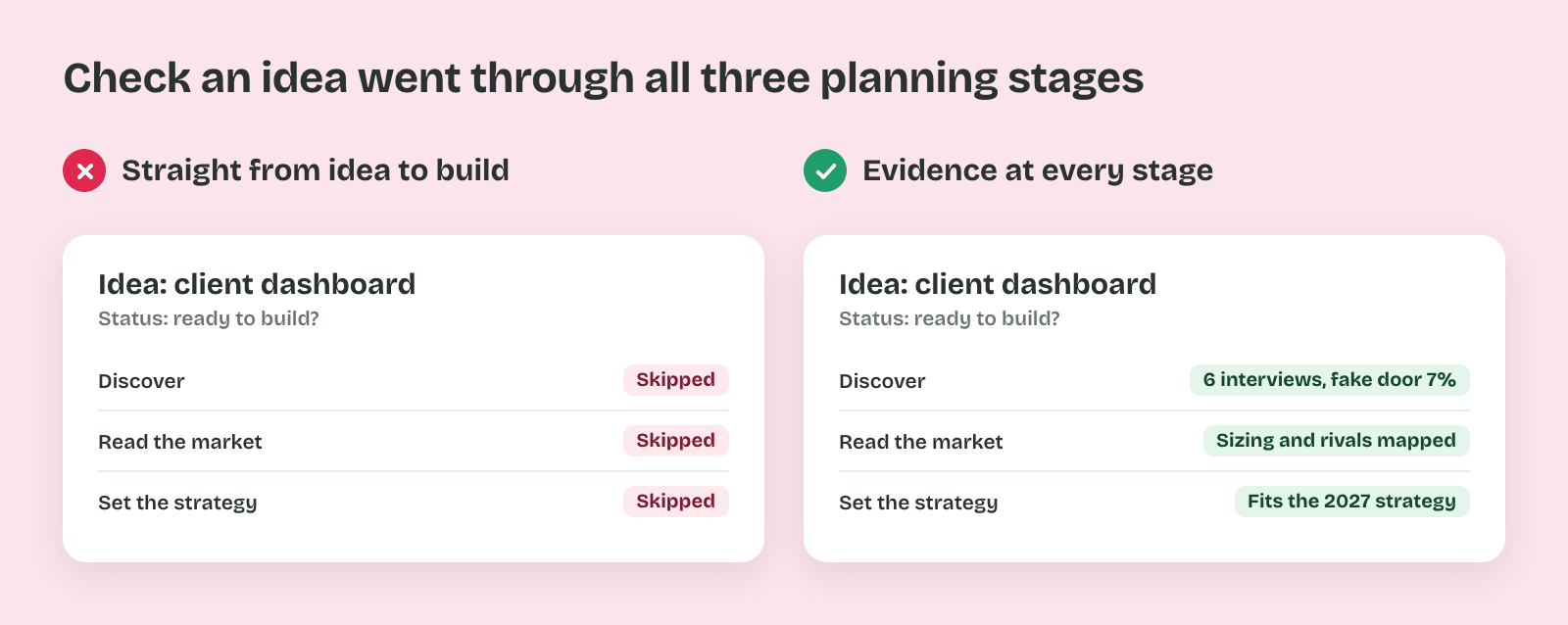
Pro tip: For any idea on the table, ask which of these three stages it has been through. An idea that skipped discovery is a guess, however confident the room feels.