Strategic Choices
A product team agrees on its strategy in January, and by March three big questions are waiting. Should it build its own invoicing or connect to an accounting tool? Should it keep fighting rivals on features or offer something they don't? And should anyone work on next year's product while this year's still has bugs?
Learn on the move: press play and turn your commute, walk or drive into time that grows your design career.

None of those questions fits a sprint, and each one shapes years of design work. A wrong answer is expensive to undo, so they deserve more care than a backlog item.
So strategic choices sit between the strategy and the roadmap. They decide how a capability gets made, which market the product competes in and how effort splits between today's product and future ones.
What Designers Do Here
These choices land on designers as integrations, new markets and early concepts. Designers judge whether a partner's piece will feel part of the product. They sketch what a new kind of offer could look like and run the cheap tests that keep future bets honest. A designer who sees the choice coming can ask for research while it can still change the decision.
Build, Buy or Partner
A project tool for agencies keeps hearing one request: send invoices from inside the product. Engineering estimates six months to build invoicing, while an accounting tool offers an integration that could ship in six weeks. A small company in the space is also up for sale. All three routes lead to invoicing, and each commits the team to something different.
That choice comes up for every capability a product needs. Laurence Capron and Will Mitchell studied it in Build, Borrow, or Buy (2012) and argued that most companies default to one route without asking which fits.
The Three Routes
Building means the team makes the capability itself. It gives full control over the experience and the data, and it costs the most time. Buying means acquiring a company or licensing its technology. It's faster, but the bought piece has to be fitted into the product. Facebook's purchase of Instagram for $1 billion in 2012 is the famous case.
The third route borrows. Partnering means connecting to another company's product, usually through an integration. It's the fastest route and the cheapest at the start, but the partner controls part of the experience and can change it. Capron and Mitchell reported that companies able to use all three routes, rather than one, were more likely to survive in their study of telecom firms.
Deciding by How the Product Wins
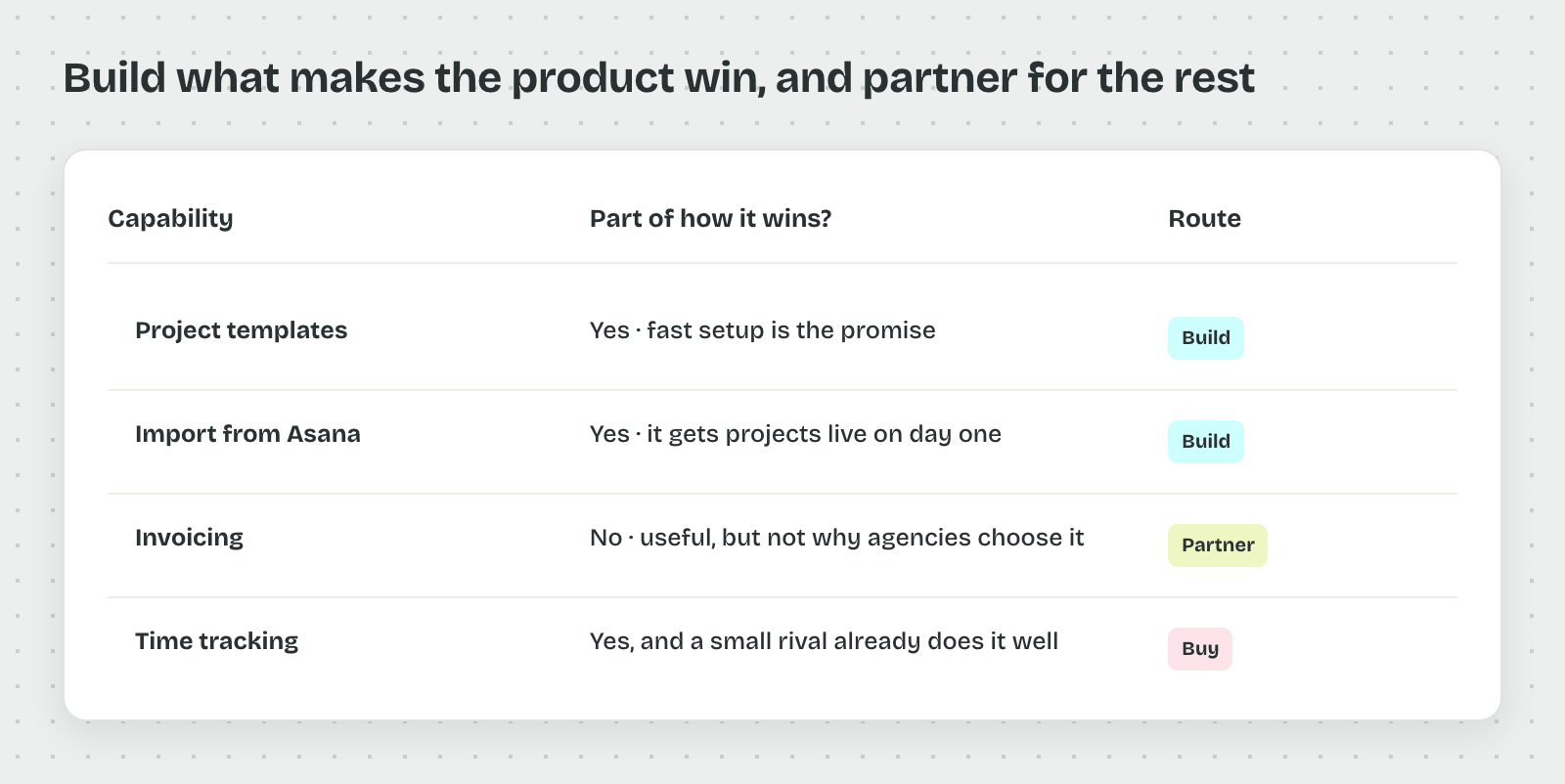
The deciding question is whether the capability is part of how the product wins. If the product wins on fast setup, then templates and importers are core, and handing them to a partner hands away the advantage. Invoicing for that same tool is useful but not why agencies choose it, so a partner can supply it.
Speed and fit decide the rest. Buying makes sense when a capability is core but too slow to build, and a company that already does it well is available. Partnering makes sense when the capability matters to customers but not to winning, and a partner does it better than the team ever would.
Where Design Shows the Seams
Every route leaves seams in the experience, and designers see them first. A partner's piece may open in a new tab, use different words or ask the user to log in again. A bought product may arrive with its own navigation and visual style. Customers notice those seams as one product that doesn't fit together.
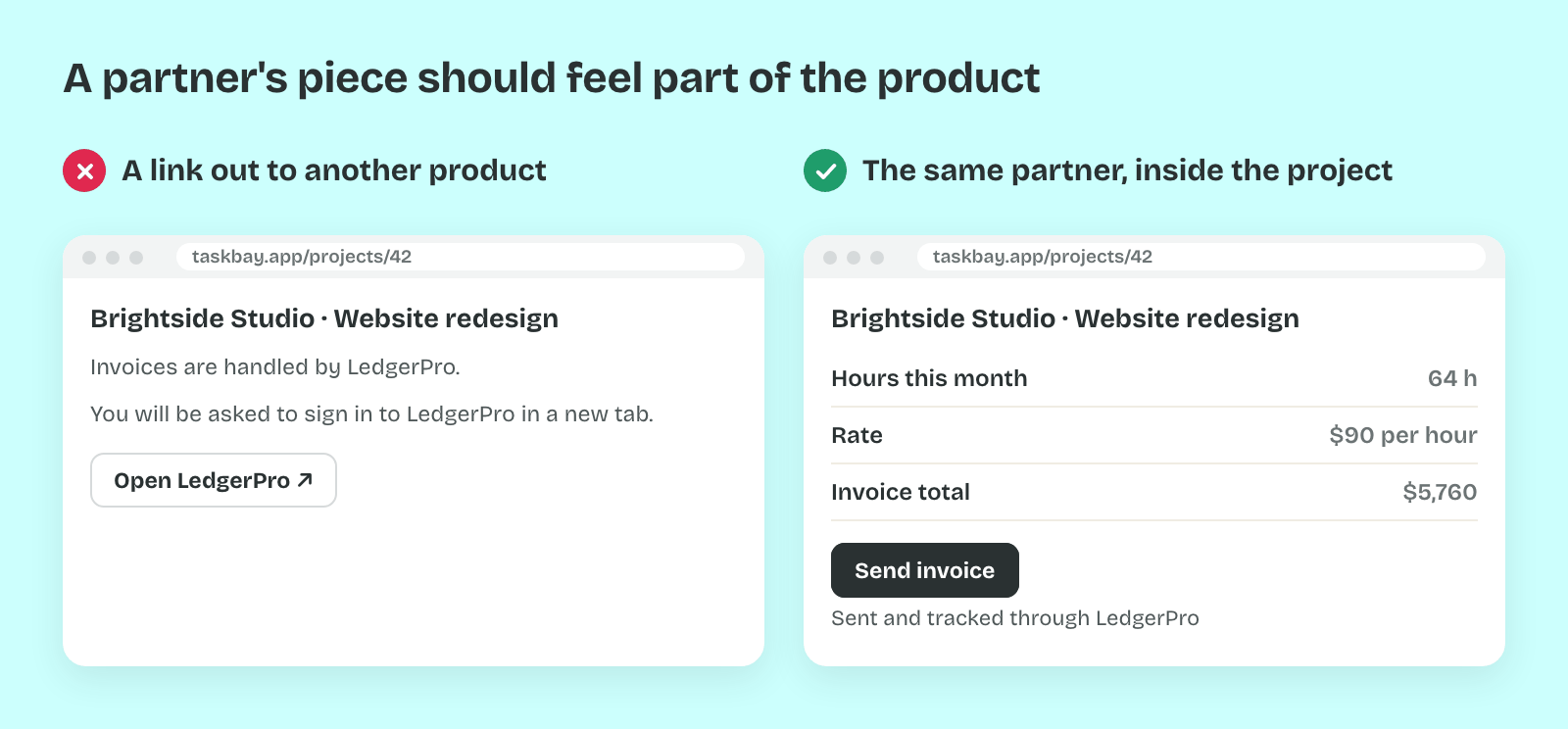
So designers should ask, before the decision, how the capability will look and feel inside the product. An integration that keeps the user on the same page, in the product's own words, costs more than a link out. It's often the difference between a feature people use and one they ignore.
The Common Mistake
The common mistake is building everything because building feels safer. Teams spend months on capabilities a partner already does well, while the core that wins customers waits. The opposite mistake, partnering for the core, gives a rival control of the reason people buy.
That trade-off is a strategic call. Estimating how long a build would take belongs to Prioritization.
Pro tip: List the five capabilities customers ask for most. Mark each one core or not core to how you win, and question every plan to build something marked not core.