
UX Advocacy & Influence
Design work often stalls after the room has already agreed with it. Imagine a usability study of a clinic booking flow, presented to leadership twice and praised both times. A year later, the findings sit in a shared folder and the flow hasn't changed.
Learn on the move: press play and turn your commute, walk or drive into time that grows your design career.

So the trouble runs deeper than any single argument. A strong case moves one decision. The next study gets acted on only if the company already treats design as part of how it works. UX advocacy is the slow work of building that habit across an organization.
Where Influence Comes From
Influence over design rests on four things a designer can work on. The first is how mature the company's UX practice is, which sets what advocacy can land. The second is whether design's results show up in the company's own numbers. The third is how much people trust the designer. The fourth is how many teams outside design want it involved.
That order matters, because each part leans on the one before it. A win record means little in a company that never measures outcomes. Trust in one designer stalls if nobody in another team repeats the case. Nielsen Norman Group estimates that one level of UX maturity can take several years to climb. So progress inside a level is measured quarter by quarter.
Because the work is long, it sits apart from winning a single review. Arguing one decision, with its evidence and its objections, is taught in Arguing Design Decisions. Working with your own manager is covered in Managing Up, part of Communicating Across Teams.
Anatomy of UX Maturity
The same advocacy move can land in one company and backfire in another. Imagine pitching a quarterly research program at the clinic booking company, where nobody holds the job title of researcher yet. The pitch gets polite nods and no budget, because the company has no structure to hold it. Here is that pitch next to one sized for the company's stage:
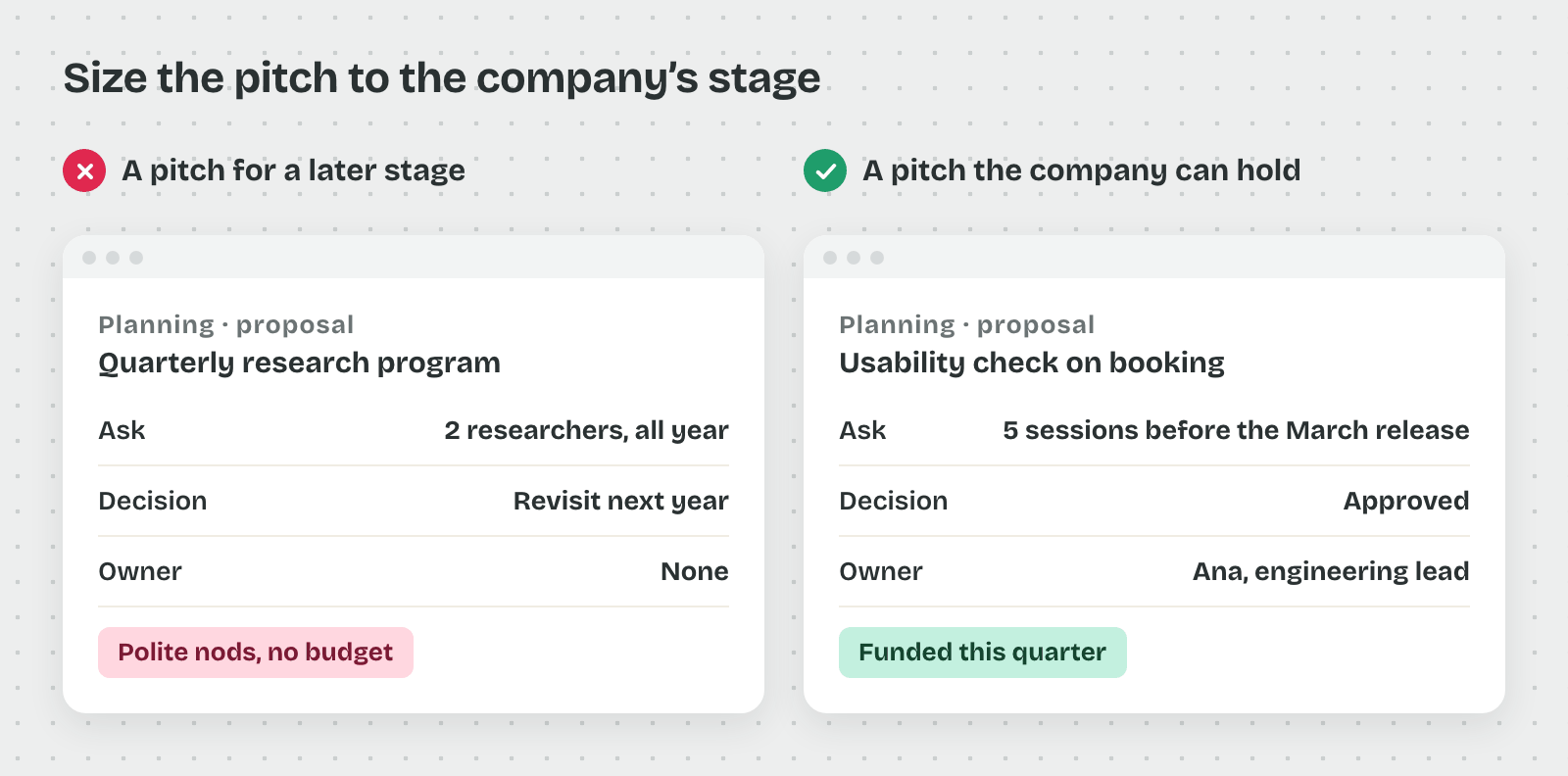
That's why reading the company comes before any pitch. UX maturity describes how far design and research have taken root in an organization. Nielsen Norman Group's model gives it six named stages.
The Stages of UX Maturity
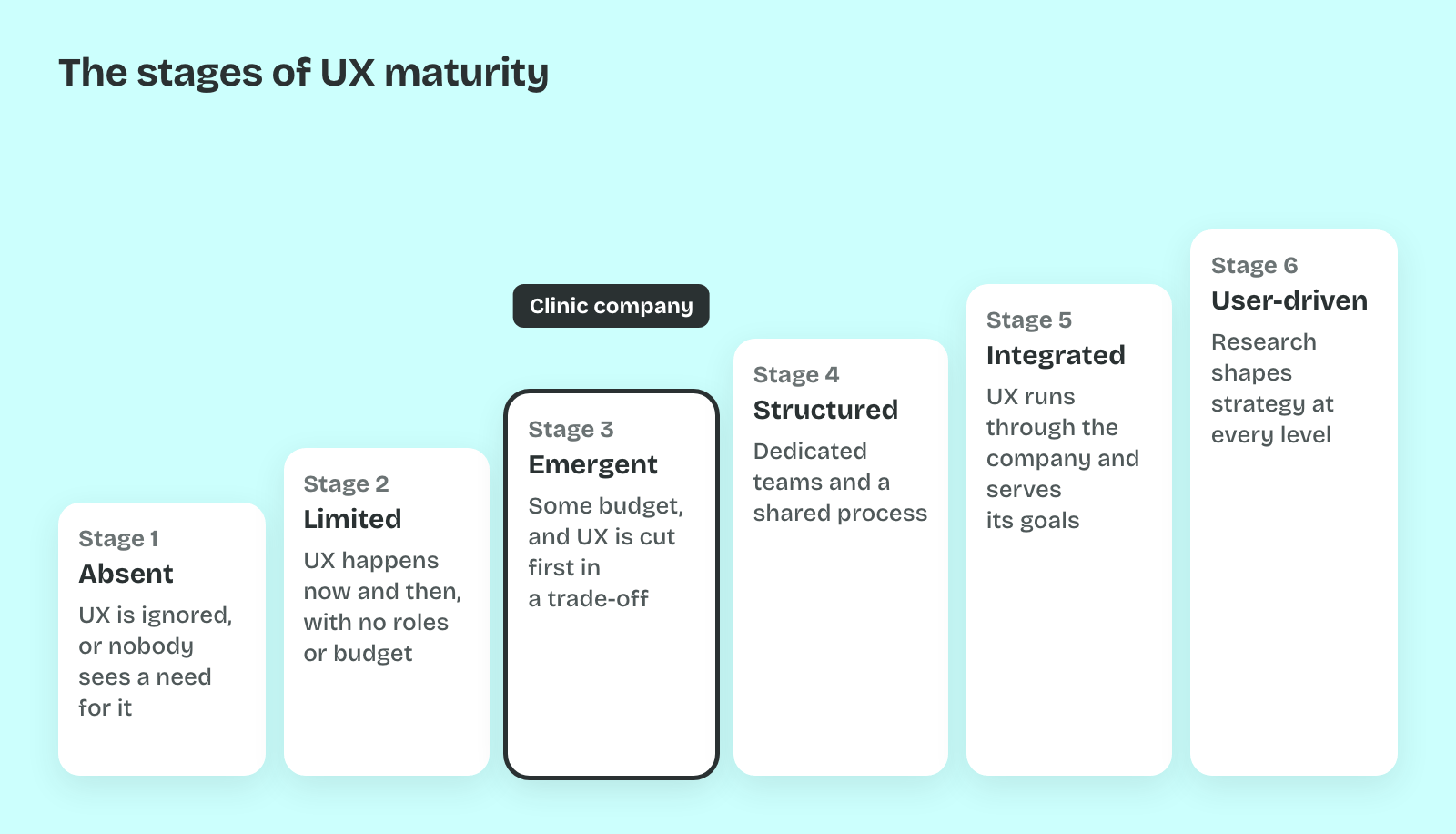
Kara Pernice, Sarah Gibbons, Kate Moran and Kathryn Whitenton published the model for Nielsen Norman Group in 2021. Each stage describes how the whole company treats UX:
- Absent: the company ignores UX, or sees no need for it.
- Limited: UX work happens now and then, with no dedicated roles, process or budget.
- Emergent: several teams do UX work with some budget, and it's the first thing cut when trade-offs come.
- Structured: the company has dedicated UX teams and a shared process, though results vary by team.
- Integrated: UX work runs through the company and serves its goals reliably.
- User-driven: user-centered thinking is a habit at every level, and research shapes strategy.
So a stage describes a whole organization, and one team can sit above or below it. Few companies reach the sixth stage, the authors write. Large enterprises in finance and healthcare often hover at the third. The clinic booking company sits at Emergent, with two designers and a research budget cut first each quarter. Here is the ladder of stages, with that company marked:
The Factors Behind Each Stage
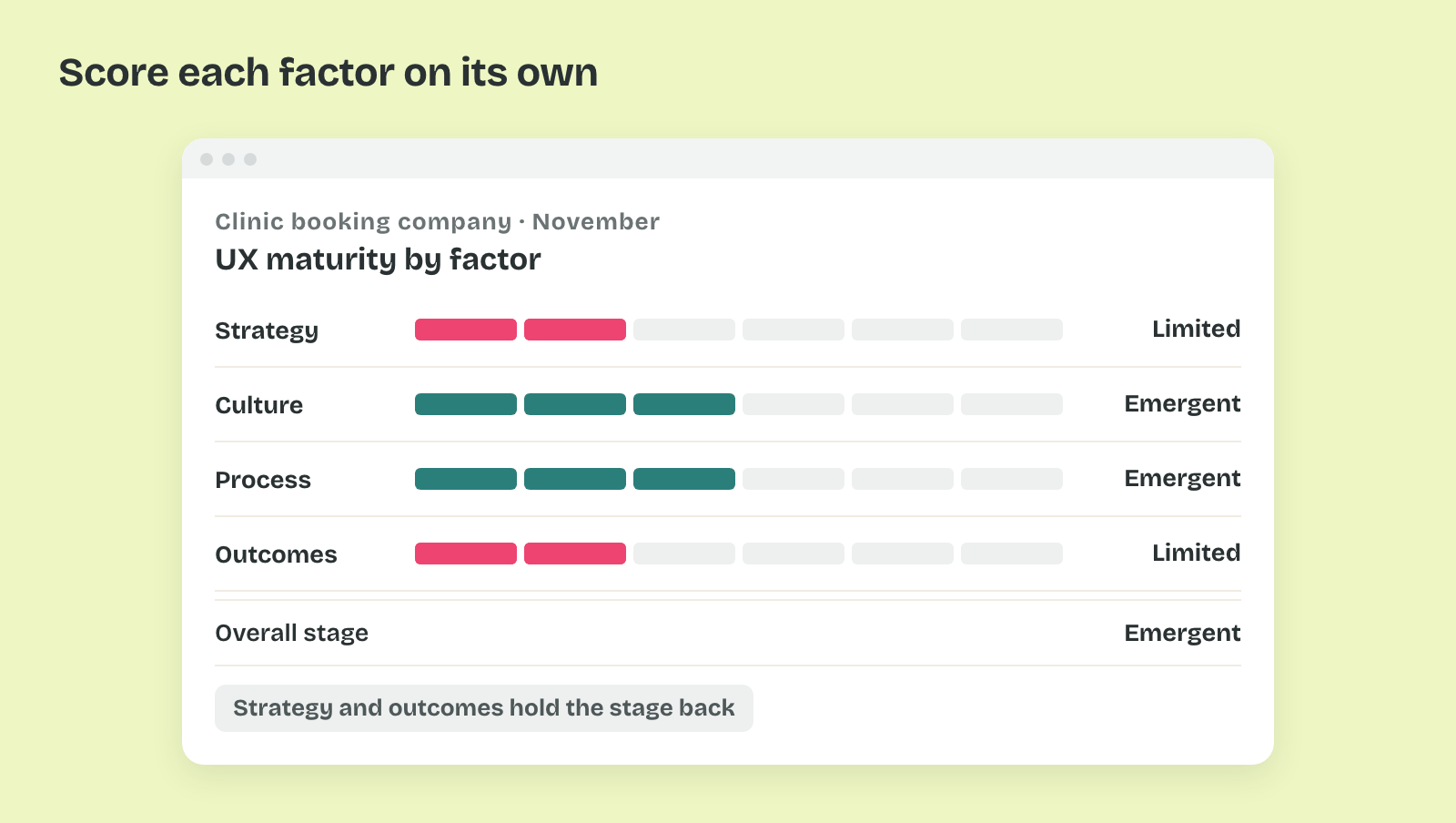
A stage is a summary, and four factors sit underneath it. Strategy covers UX leadership, planning and how resources get prioritized. Culture covers how much people know about UX and whether UX careers can grow. Process covers how consistently teams use research and design methods. Outcomes covers whether the company defines and measures what UX work produces.
That split matters because the factors rarely sit at the same level. A company can run a solid design process and still measure nothing, which leaves process ahead of outcomes. The weakest factor usually explains why the stage hasn't moved. At the clinic company, culture and process sit at Emergent, while strategy and outcomes sit at Limited. Here is that factor scorecard:
Reading Where Your Company Stands
Nielsen Norman Group offers a free, self-reported maturity quiz, and it makes a good first pass. A self-report still reflects how people feel about UX, and feelings often run ahead of practice. For a full evaluation, the authors recommend several assessment methods.
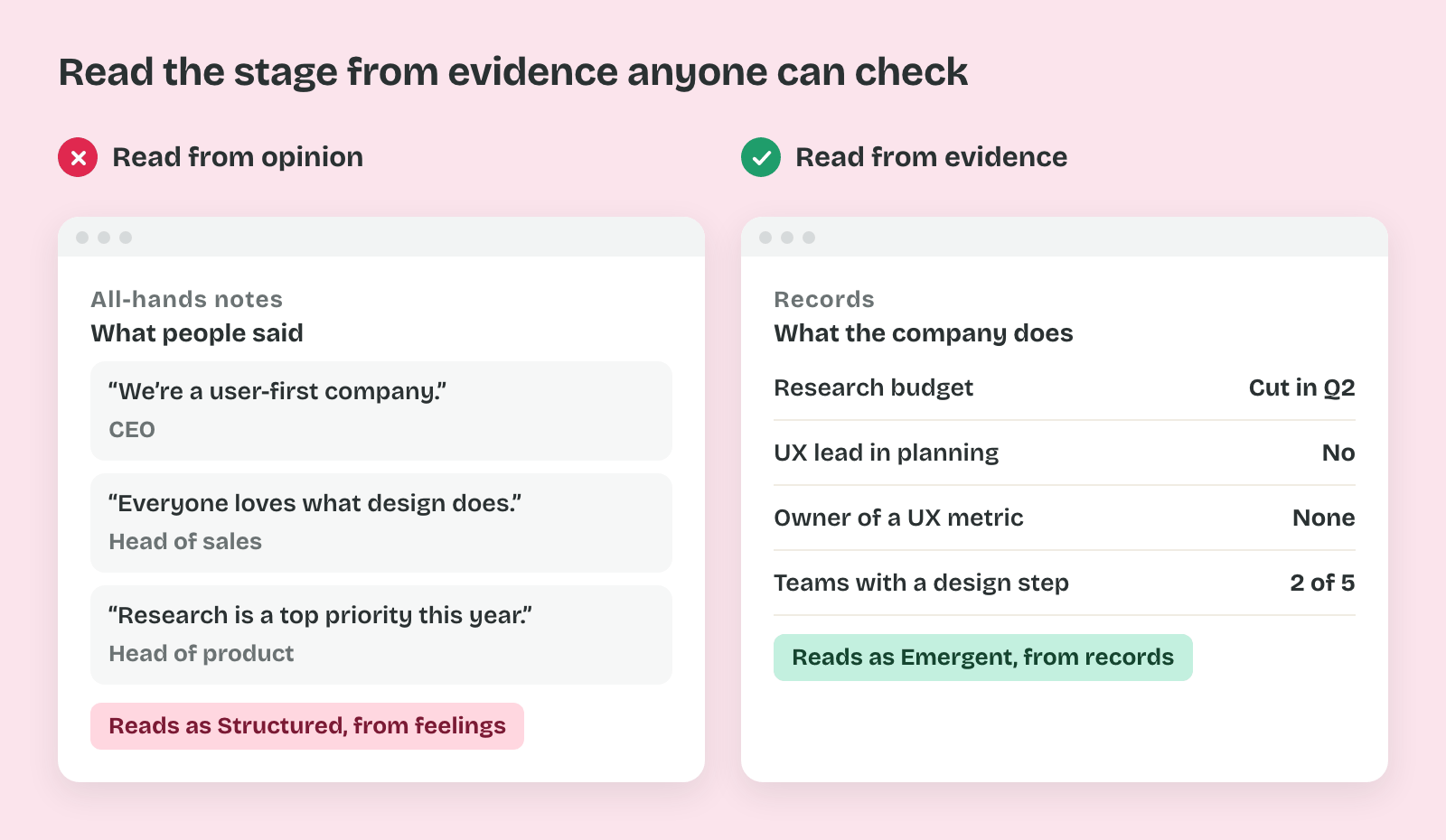
So read the stage from evidence anyone can check. Look for a research budget line, a UX lead in planning and a named owner of a UX metric. Then ask what got cut when the roadmap was last tight, since at Emergent UX is "still the first to go." Here is the same company read from opinion and from evidence:
Moving up a Stage
Companies move one stage at a time. Nielsen Norman Group puts a single level at several years of work. It calls skipping a level unrealistic. A designer at an Emergent company who pitches research-led strategy asks for something the company has no structure to hold.
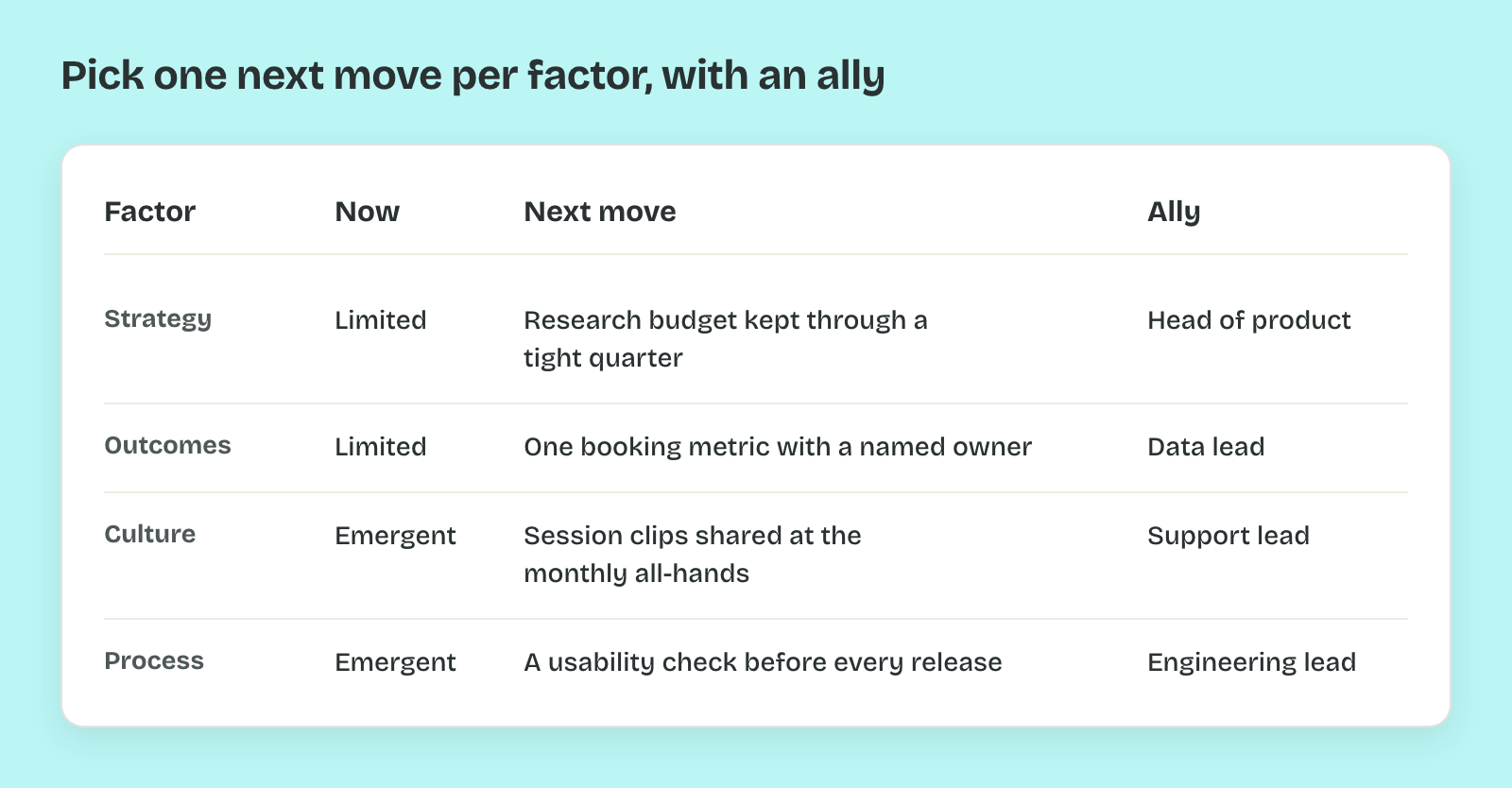
That's why the useful question is the next stage and the weakest factor. For the clinic company, reaching Structured starts with protected research money and one UX metric with an owner. Each move needs an ally who owns that thing, like the head of product for the budget. Here is the next move for each factor at the clinic company:
Pro tip: Score the four factors again every six months and keep the old score beside the new one. Movement inside a stage is slow and easy to miss, and two written scores show you which move worked.